
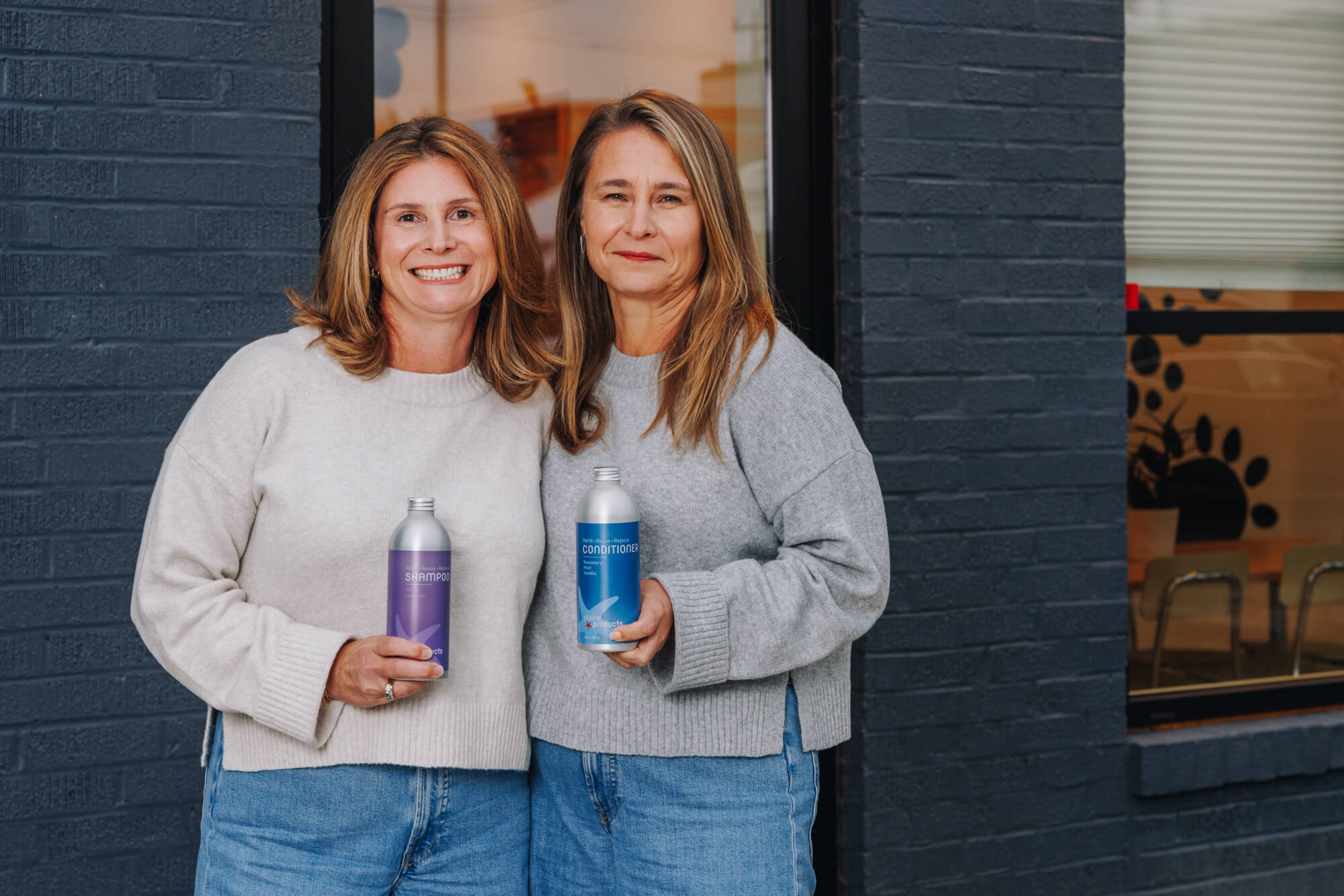
I've been thinking about what makes a business model genuinely circular versus one that just uses the word. A refillable glass jar you keep on your bathroom shelf is a good start. A refillable aluminium bottle with a return system — where you send it back, it gets washed, and it goes out to the next customer — is something structurally different. That's not a packaging choice. That's a supply chain redesign.
That's what Plaine Products built. And it's why they appear in our best refillable shampoo guide — not just for the quality of what's inside the bottles, but for the rigour of the system around them.
A Founder Story That Starts in The Bahamas
Plaine Products began with a phone call between two sisters. Lindsey had been living in The Bahamas, where the consequences of plastic pollution are impossible to ignore — it washes up on beaches, entangles marine life, and accumulates in communities that often have the least capacity to address it. She called her sister Ali with a question: what if there was an easier, better way?
That question turned into more than a year of research into safe, non-toxic formulas and testing refillable packaging that could actually work in people's lives. The result was Plaine Products — a company built, from the ground up, to eliminate single-use plastics from the bathroom. Not to reduce them. To eliminate them.
"What I find most honest about Plaine Products' founding story is that it comes from direct encounter — not from a market opportunity or a trend report. Lindsey saw what plastic pollution looks like when you live somewhere the ocean isn't abstract. That's a different kind of motivation, and it tends to produce a different kind of company. When I look at the depth of their certification stack, their annual impact reports going back to 2017, and their supply chain transparency, I see a business that built accountability into its structure rather than bolting it on for marketing purposes."
Plaine Products is headquartered in Milford, Ohio, and operates as a certified women-owned business. Their physical shopfront at 743 Lila Ave is open Monday through Friday, where customers can pick up refill bottles and drop off empties in person — a level of community rootedness that's genuinely unusual for a direct-to-consumer brand.
The Refill System: What "Circular" Actually Looks Like in Practice
Most brands that use "sustainable packaging" mean they've switched to a different single-use format — a glass jar instead of a plastic bottle, or a compostable pouch instead of a plastic bag. These are improvements. But Plaine Products went further: their aluminium bottles are designed to be returned, washed, and refilled. The bottle you use is not the bottle's final journey.
Product Arrives
Replace the lid with the pump included. Use your product as normal.
Running Low?
Order your refill. Reuse the same pump — no new parts needed.
Return the Empty
Rinse the empty bottle, place it in the refill box, and mail it back using the return label from the website.
The shipping boxes are part of the system too. Plaine Products worked with their box supplier — Pratt Industries, a local Ohio company — to develop boxes strong enough to handle both outbound shipments and inbound returns. Each box is reused an average of five times before being recycled. The boxes are sealed with reinforced paper tape, ensuring they remain fully recyclable at end of life.
"The box detail is the kind of thing that gets overlooked in supplier features, and I think it's actually one of the most revealing things about how Plaine Products operates. They didn't just choose sustainable packaging for the product — they thought about the packaging that carries the packaging. That systems thinking, applied at every layer of the supply chain, is what separates genuine circularity from greenwashing. Most brands stop at 'our bottle is refillable.' Plaine Products asked: what happens to the box it arrives in?"
The Certifications: A Stack That Requires Genuine Accountability
Plaine Products holds one of the most comprehensive certification stacks I've encountered in this category. Each one requires something real — third-party auditing, documentation, ongoing recertification — rather than self-declaration.
| Credential | What It Means in Practice |
|---|---|
| B Corp | Requires documented evidence across five impact areas: workers, community, environment, customers, and governance. Independently audited, not self-reported. Must recertify regularly. |
| Leaping Bunny | Verifies no animal testing at every stage — not just the finished product, but each ingredient supplier in the chain. More rigorous than brands self-declaring cruelty-free. |
| WBENC Women-Owned | Independent certification that the business is at least 51% owned, operated, and controlled by women — not a marketing badge. |
| 1% for the Planet | 1% of annual revenue (not profit) to vetted environmental nonprofits — verified. Plaine Products directs funds to Beyond Plastics, Plastic Ocean Project, Orange County Coastkeeper, Plastic Free Future, and others. |
| Annual Impact Reports | Published every year since 2017 — eight consecutive years of documented transparency covering greenhouse gas emissions, packaging waste, and community partnerships. Downloadable from their website. |
| FDA-certified manufacturing | Florida-based product manufacturer holds FDA certification and a Good Manufacturing Practices certificate. Plaine Products makes semi-annual in-person visits to the facility. |
What's in the Bottles — and What Isn't
The formulas are plant-based, vegan, non-GMO, biodegradable, and described by Plaine Products as baby-safe and hypoallergenic. Fragrances come from pure essential oils and botanical aromatics — no synthetic fragrance compounds. The ingredient transparency page lists every ingredient by INCI name alongside its common name, what it does, and which products it appears in.
✓ Key Ingredients
- Aloe vera — conditions hair, soothes skin; packed with vitamins A, B, C and E
- Rosehip oil — rich in omega fatty acids and antioxidants including vitamins E and A
- Shea butter — deep moisturiser; strengthens and softens hair, improves shine
- Jojoba seed oil — contains vitamins E and B; outstanding moisturiser, helps combat dandruff
- Sunflower seed oil — reduces inflammation, softens and smooths hair and skin
- Green tea extract — antioxidant, anti-inflammatory, UV protective
- Rosemary leaf extract — antimicrobial; nourishes dry hair and improves thickness
- Vitamin E (Tocopherol) — antioxidant; protects skin barrier, keeps hair strong and shiny
✗ What You Won't Find
- Sulfates — no harsh stripping surfactants
- Parabens — no artificial preservatives
- Phthalates — no endocrine-disrupting plasticisers
- Silicones — no build-up over time
- Palm oil — avoided for environmental reasons
- Synthetic fragrances — essential oils and botanical aromatics only
- Single-use plastic — at any stage of the system
On preservatives: Plaine Products use Gluconolactone and Sodium Benzoate (Geogard Ultra) and Potassium Sorbate — both described on their ingredients page as non-toxic preservatives that prevent harmful bacteria and mould growth while remaining biodegradable. This is the kind of transparency that matters: they name the preservatives, explain what they do, and confirm they're safe for the environment downstream. That's meaningfully better than a vague "naturally preserved" claim.
The Product Range: Built Around Hair Care, Extended Into Skin
Hair Care
The hair care range is organised around what your hair needs rather than generic product types. Plaine Products offer specific collections for Cleanse & Clarify, Color Care, Gentle & Fragrance Free, Style & Finish, Boost Volume, Smooth Frizz, and Hydrate, Balance & Repair. There is also a dedicated "Ask A Hair Stylist" resource on their site for personalised guidance — an unusual and genuinely useful feature for a brand navigating the diverse needs of different hair types.
Skin and Body Care
The refillable system extends across the full body routine. All products arrive in the same aluminium bottle format and work within the same send-back-and-refill system — meaning one decision to switch to Plaine Products can eliminate plastic across your entire shower routine, not just your shampoo. Travel sizes and gallon sizes are also available for different household and travel needs.
The Values That Actually Guide Decisions
Plaine Products publishes seven core values on their Our Story page. I'm quoting them because they're specific enough to be meaningful, and because the company's operational choices — the supply chain decisions, the nonprofit partnerships, the impact reports — reflect them in ways that are verifiable rather than decorative.
Progress, Not Perfection
"We don't see zero waste as the goal. Every small action matters and adds up. We celebrate progress, not perfection."
Collaboration Over Competition
"We know we can't solve the plastic crisis alone. That's why we partner with like-minded nonprofits, businesses, and advocates to create lasting impact."
Transparency
"We believe honesty builds trust, and trust drives change. We're committed to being open about what's in our products, how our reuse system works, and how we operate as a business."
Equity & Access
"We believe everyone deserves access to sustainable options. We work with nonprofit partners to expand access to low-waste solutions where they're needed most."
"'Progress, not perfection' is the value I find most credible — because it's the one most brands are too afraid to say. Sustainable brands tend to present themselves as having solved the problem. Plaine Products' framing acknowledges that no one has. That kind of honesty is actually harder to maintain than a polished sustainability narrative, because it requires you to keep doing the work rather than resting on the story you've already told. Eight years of annual impact reports is a direct manifestation of that value."
The Nonprofit Network: More Than a Donation
Plaine Products' 1% for the Planet membership funds a specific and documented set of partner organisations, not a general environmental fund. The partnerships span four distinct areas of impact:
Advocacy: Beyond Plastics — combining environmental policy expertise with grassroots advocacy, including support for the New York Packaging Reduction and Recycling Infrastructure Act. Plaine Products is also a member of Upstream's Reuse Solutions Network and the Innovation Alliance for a Global Plastics Treaty.
Education and awareness: Plastic Ocean Project and Bernheim Arboretum and Research Forest, among others.
Cleanups: In partnership with Orange County Coastkeeper, Plaine Products organises cleanup events to remove plastic waste from beaches and waterways. During their shopwide sales — held approximately three times a year — they commit to removing one pound of trash for every purchase made.
Environmental justice: Bulk product donations to Plastic Free Future, a California-based nonprofit whose reuse programme focuses on supporting systemically excluded communities.
The Supply Chain They Built
Plaine Products' approach to their supply chain is worth understanding, because it's not what most brands do. They keep three factors in mind when making supply chain decisions: proximity (to reduce shipping distances), product quality, and the ethics of the supplier — including fair labour practices and environmental responsibility.
Their aluminium bottles come from the local Ohio branch of Trivium. Their boxes come from the local office of Pratt Industries, whose award-winning packaging is made from 100% recycled material. Their product manufacturer is based in Florida — an FDA-certified facility with a Good Manufacturing Practices certificate that Plaine Products visits in person twice a year.
All main suppliers are based in the US. That's a deliberate constraint that limits their options and sometimes increases costs. It's also the kind of supply chain decision that makes their transparency claims credible rather than theoretical.
How Plaine Products Fits Into an Ethical Bathroom
At AnthroEvolve, we think about the ethical bathroom as a system of decisions that compound over time. Shampoo and conditioner are among the highest-frequency purchases in a bathroom routine — replaced every few weeks for many households. The cumulative environmental impact of those purchases, repeated across years, is substantial. Plaine Products' refillable system addresses that compounding impact structurally: once you're in the system, every refill is a plastic bottle that doesn't get made, doesn't get shipped in virgin plastic, and doesn't end up in a recycling stream that may or may not actually process it.
The aluminium bottle is infinitely recyclable — and more importantly, it's designed not to need recycling, because it keeps circulating. That distinction matters when you're thinking about the bathroom not as a series of individual product choices but as a system you're designing for the long term.
Where you'll see Plaine Products in our guides: Plaine Products appears in our best refillable shampoo guide as the brand with the most rigorous return-and-reuse system in the category — backed by B Corp certification, annual impact reports, and a supply chain built for transparency rather than convenience.
Explore Our Ethical Bathroom Guides
This feature is part of AnthroEvolve's research into the most sustainable and transparent bathroom products available. The guides below go deeper on specific categories — with the same ingredient scrutiny, certification checks, and honest trade-offs you've come to expect from us.
Ready to Enter the Refill System?
Explore Plaine Products' full range of refillable hair care, skin care, and body care — formulated with plant-based ingredients, certified by B Corp and Leaping Bunny, and built to keep plastic bottles out of landfill for good.
Visit Plaine Products →Disclosure: AnthroEvolve and Plaine Products have a reciprocal linking arrangement — Plaine Products links to AnthroEvolve in exchange for this feature. This is disclosed in accordance with FTC guidelines. Our editorial policy is unchanged: we only feature brands we would recommend independently of any commercial arrangement. Plaine Products' inclusion in our refillable shampoo guide is based entirely on their credentials, formulations, and the rigour of their reuse system.